The Hidden Cost of Unprepared M&A: Why 70% of Deals Destroy Value
Table of Contents
Most founders spend years building something worth acquiring — and weeks preparing it for the deal table. It's an imbalance that shows up in the data: roughly seven out of ten M&A transactions fail to create the value they promised. Not because the businesses were flawed, but because the financial foundations weren't ready for scrutiny.
This isn't a story about bad deals. It's about good businesses that weren't prepared to demonstrate their value under the unforgiving lens of due diligence. And for founders in the $5M to $50M revenue range, where every dollar of EBITDA directly affects the multiple, the cost of unpreparedness is measured in hundreds of thousands — sometimes millions.
The Valuation Gap Nobody Talks About
There are two valuations in every deal. The first is the one the founder carries in their head — shaped by years of sweat equity, revenue growth, and the figure their accountant mentioned at last year's review. The second is the one that emerges when a buyer's advisory team opens the data room.
The gap between these two numbers is where deals collapse. Not at the negotiation table, but in the quiet weeks of financial review where every assumption is tested against documentation.
The gap between what a founder believes their business is worth and what a buyer can verify is where most deals quietly collapse.
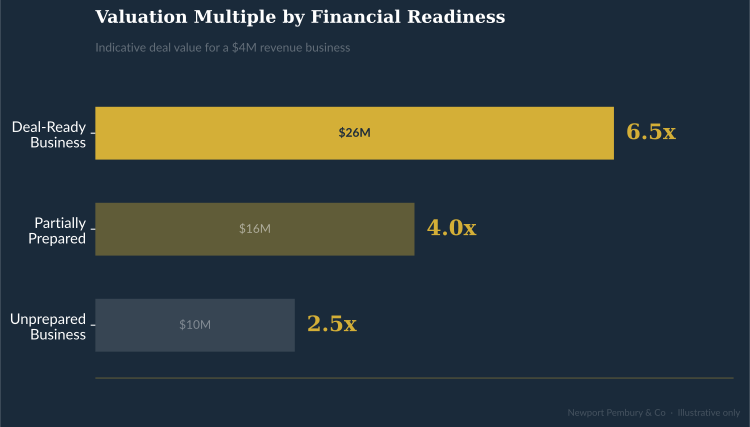
We see this pattern repeatedly in our advisory work. A founder with a genuinely strong business — $4M in revenue, healthy margins, recurring clients — enters an acquisition conversation expecting a 5x to 6x multiple. But their financials tell a muddled story: revenue recognition policies that shift year to year, key customer contracts that live in email threads rather than signed agreements, and cost allocations that would challenge even a seasoned analyst.
The buyer's team doesn't see a $4M business worth $24M. They see risk. And risk compresses multiples.
of M&A transactions fail to create the value they promised to shareholders
Harvard Business Review — M&A Research
Due Diligence: Where Deals Go to Die
Due diligence is not a formality. It is a forensic examination of every financial claim a business makes. For founders who've built their company with operational excellence but financial pragmatism, this process can be deeply confronting.
The common failure points are surprisingly consistent:
- Revenue quality — Is revenue recurring, contractual, or project-based? Buyers pay very different multiples for each.
- Earnings normalisation — Are owner benefits, one-off costs, and related-party transactions clearly separated? Muddled earnings create doubt.
- Working capital patterns — Does the business consume cash as it grows, or generate it? This directly affects the price paid at completion.
- Customer concentration — If one client represents 30% of revenue, the buyer is acquiring a dependency, not a diversified business.
- Systems and reporting — Can the financial team produce accurate monthly P&L, balance sheet, and cash flow within 10 business days of month-end? If not, the buyer questions everything.
Each of these issues, individually, is manageable. Together, they form a pattern that signals to buyers: this business hasn't been run with an exit in mind. And that perception — whether fair or not — costs real money at the deal table.
Free Resource
Get the M&A Readiness Checklist
12 financial benchmarks your business should meet before approaching a buyer. See where you stand.
Send Me the ChecklistBuilding the Financial Infrastructure
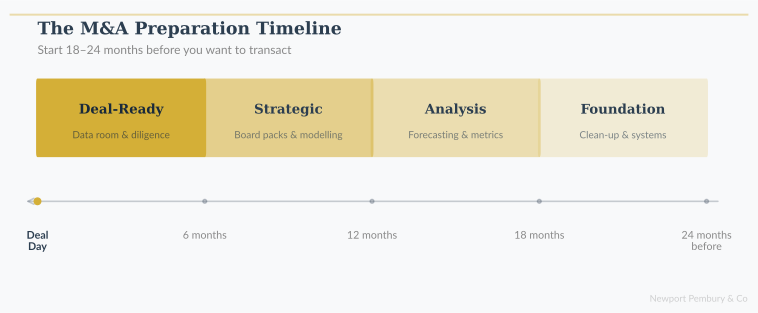
The businesses that command premium multiples share a common trait: their financial infrastructure was built 18 to 24 months before anyone started talking about a transaction. Not because the founders planned to sell — though some did — but because they recognised that the disciplines required for a successful exit are the same ones that make a business better to run.
The financial disciplines that command premium multiples in a deal are the same ones that make a business better to run every day.
In our experience, the financial infrastructure that transforms deal outcomes includes three layers:
Three Layers of Deal Readiness
Layer I
Foundation
Clean chart of accounts, consistent revenue recognition, and accurate financials within 10 days of month-end.
Layer II
Analysis
Rolling 13-week cash flow forecasts, monthly variance analysis, and unit economics by service line.
Layer III
Strategic
Board-ready reporting packs, scenario modelling, and a documented financial operating rhythm.
This sounds basic because it is — and yet, in our advisory practice, fewer than one in five businesses in the $5M to $50M range have even the foundation layer in place when they first engage us. The analysis layer turns historical data into forward-looking intelligence — exactly what a buyer needs to underwrite future performance. And the strategic layer is what separates a business that can be acquired from one that commands a premium.
The Founder Blind Spot
There's a cognitive bias at work in nearly every unprepared deal. Founders who've built a business from nothing develop a deep, intuitive understanding of its value. They know which clients are loyal, which revenue streams are growing, and which team members are irreplaceable. This knowledge is real and valuable — but it's invisible to a buyer who can only see what's documented.
The founder's blind spot is the assumption that the buyer will see the business the way they do. They won't. A buyer sees a spreadsheet, a data room, and a management presentation. If the story those documents tell is incomplete, the buyer fills in the gaps with their own assumptions — and those assumptions always discount value.
In our early M&A advisory work, we underestimated the timeline for financial clean-up. A business that we believed was six months from deal-readiness turned out to need fourteen months of foundational work before we could confidently open a data room. That experience fundamentally shapes how we prepare founders today: we start with the assumption that the financial infrastructure needs more work than anyone expects.
Preparing for Value, Not Just Transaction
The most important shift a founder can make is to stop thinking about M&A preparation as deal preparation and start thinking about it as value preparation. The distinction matters because it changes the timeline, the priorities, and the mindset.
Deal preparation is reactive — it starts when a buyer appears or when a founder decides to sell. Value preparation is proactive — it starts the moment a founder decides that their business should be worth what they believe it's worth, whether they sell next year or in ten years.
The practical steps are deceptively straightforward:
- Audit your data room readiness — Could you open a virtual data room tomorrow and populate it with 24 months of clean financials, all key contracts, and a management presentation? If not, start here.
- Commission a quality of earnings analysis — Before a buyer does it, do it yourself. Understand what your normalised EBITDA actually is and what adjustments a buyer would make.
- Map your revenue quality — Categorise every revenue stream by type (recurring, contractual, project), customer tenure, and concentration. This is the single most impactful analysis for valuation.
- Build the reporting cadence — Monthly financials within 10 days, quarterly board packs, annual strategic review. The discipline itself is a signal to buyers.
None of this requires a transaction in progress. All of it makes the business more valuable, more investable, and more resilient — regardless of what comes next.
The Bottom Line
- Roughly 70% of M&A deals fail to create promised value — most often due to financial unpreparedness, not business quality.
- The gap between founder perception and buyer verification is where multiples compress and deals collapse.
- Financial infrastructure should be built 18–24 months before any transaction conversation begins.
- Three layers of readiness — foundation, analysis, and strategic — separate premium outcomes from discounted ones.
- Value preparation is proactive and ongoing; deal preparation is reactive and expensive.